Wednesday, February 8, 2012
ELL Lab Weather Reports
Seven students in our room go to the ELL lab every day. They had to opportunity to plan out and present thier own weather reports. We'd like to share them here:

Title: The Edmund Fitzgerald
We learned about the Edmund Fitzgerald (Big Fitz for short) in ELA. The story of the Big Fitz is a lot like the story of the Titanic. Both of these ships were huge and both of these ships sunk.


The Big Fitz was actually named after a man named Edmund Fitzgerald. This ship was a cargo ship and it carried iron ore pellets from the United States to Canada on Lake Superior. It also carried 29 crew men that worked on and painted the ship.
On November 9, 1975 the Fitz made its last voyage. A storm hit and the Big Fitz was communicating with another ship caught in the storm. Suddenly, the Big Fitz vanished from their radar screen. No one knows exactly how the Big Fitz sunk. We may never know how this ship sunk. It still lies at the bottom of Lake Superior.

How do you think the Big Fitz sunk?
Friday, January 20, 2012
Gifts!
I wanted to take a minute to show off and express my gratitude for the gifts that students gave to our classroom this year! I personally received some lovely gifts, which I really appreciate. This year, I also asked for some "wish list" items for the room.

As you can see, we received a variety of games for inside recess, some legos, and some markers and glue. The kids loved opening the gifts together and were excited to play our new games. Thank you so very much!
Love, Mrs. Lopez
Counting 1,000
It’s Math time! Why do we have pull tabs and toothpicks in Math?
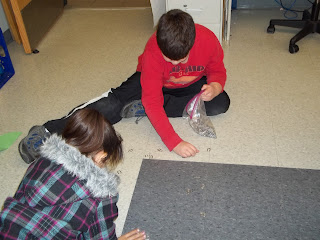
We collected pull tabs to try to get 1000. We collected so many we had to group them to make it easier to count. We worked in 4 table groups. At each table we put the pull tabs into groups of 10 to get a total for the table. Then we added the 4 table totals to get a whole class total. All together our class collected 2,200 pull tabs.
For the toothpicks we had extras from a Thanksgiving turkey project. There were so many we decided to group them too. We made groups of 10 and put them in bags to make groups of 100. Then we counted the 100’s bags to get 1,250 total toothpicks.
We discovered it was faster and easier to count large amounts by putting them in groups of 10 and 100. You could try it with large amounts of paper clips or coins. Let us know how many you get.
Written by Holly and Billy



Written by Holly and Billy


Wednesday, December 7, 2011
How to "Read to Someone"
In our classroom we are doing the Daily 5. One of the things in Daily 5 is " Read to Someone."
This is what we do:
Get your Book Box.

Find a good spot to read.
 Sit on your bottoms-- Elbow to elbow, Knee to knee (EEKK!)

Choose something to read.
Take turns reading to each other in partner voices.

Read to someone is good becasue we like it and we like to pracitce reading.

Maybe you should try reading to someone too!
This is what we do:
Ask a classmate to read with you.

Get your Book Box.

Find a good spot to read.


Choose something to read.
Take turns reading to each other in partner voices.

Read to someone is good becasue we like it and we like to pracitce reading.

Maybe you should try reading to someone too!
How to Use Xtra Math
Xtra math is done on a computer. We use it to practice math facts. We are working to get better at addition facts. After we log-in and get to Xtra Math we click the start button.

A math fact is on the screen like 6+2= we use the numbers on the keyboard to enter an answer.

If you get it right,you go on to the next question. If you get it wrong, you will see the answer. You have to type the answer to get the next fact. You have 10 seconds to answer. We can do Xtra math in the computer lab, in the classroom, or at home. We just have to remember our individual PIN numbers.
Do you think you would like to try Xtra Math too?
Click the link here: Xtra Math to go to the site.

A math fact is on the screen like 6+2= we use the numbers on the keyboard to enter an answer.

If you get it right,you go on to the next question. If you get it wrong, you will see the answer. You have to type the answer to get the next fact. You have 10 seconds to answer. We can do Xtra math in the computer lab, in the classroom, or at home. We just have to remember our individual PIN numbers.
 |
| The green dots time how long it takes you to answer. |
 |
| This is what it looks like if you take too long. |
 |
| Here is an example of the results of a quiz. The Smiley faces are for correct answers. |
Do you think you would like to try Xtra Math too?
Click the link here: Xtra Math to go to the site.
The Water Cycle

In science we are learning about the water cycle. We made our own water cycle in a baggie. You can too. Here is how you do it:
Materials:
1 plastic bag with a ziplock top

1/4 cup of water
masking tape
Steps:
1. Use the marker to write these words on the bag:
condensation, evaporation, precipitation
2. Pour the water into the bag. Zip it tight.
3. Use the tape to tape the bag to a window.
4. Observe what happens.
Now you have your own water cycle!
Please tell us what you think of this project.
If you try this yourself, comment about what you observed.

Subscribe to:
Posts (Atom)